

PayFlow Data Platform






















End-to-end data engineering platform for PayFlow, a fictional digital-payments fintech. Built on synthetic data and a 100% free, open-source stack. Covers the full data lifecycle: real-time ingestion, a cloud lakehouse with Medallion architecture, ML-powered fraud detection, pipeline orchestration, and a streaming layer for millisecond-latency decisions.
Architecture
A real fintech runs two parallel pipelines. PayFlow implements both.
The batch pipeline trains the model on historical Gold features. The streaming pipeline scores each transaction in real time using that model before the payment clears. The fraud score is written back to PostgreSQL, where Airbyte picks it up in the next sync cycle; that feedback becomes part of the next training run, closing the loop. Retraining is automatic: the last step of every Prefect run counts how many new rows have accumulated in gold_fraud_features since the previous training and triggers train.py whenever the threshold is met (default 1,000 rows, configurable via MIN_RETRAIN_ROWS). The checkpoint is stored in ml/last_trained_rows.txt.
Gold data is loaded into BigQuery as the analytical warehouse after merchant names are normalized via pgvector. Looker Studio reads a snapshot extracted from BigQuery for dashboards and reporting (see the Looker Studio section for why).
Stack
| Layer | Tool |
|---|---|
| Data simulation | Python, Faker, NumPy |
| Operational sources | PostgreSQL 16, MongoDB 7, FastAPI |
| Ingestion | Airbyte (incremental + full-refresh) |
| Lakehouse storage | Cloudflare R2 (Parquet + Delta Lake) |
| Transform / compute | dbt + DuckDB |
| Orchestration | Prefect |
| Machine learning | XGBoost + scikit-learn + MLflow |
| Real-time serving | Apache Kafka + FastAPI |
| Merchant normalization | pgvector + sentence-transformers |
| Analytical warehouse | BigQuery |
| BI | Looker Studio |
| Observability | Prefect UI (batch) + Grafana / Prometheus (streaming) |
| Data quality | dbt tests |
| CI | GitHub Actions |
Repository layout
| Path | Role |
|---|---|
simulator/ | Synthetic transaction and fraud generator (bulk_seed.py for the historical bootstrap) |
sources/postgres/ | Schema: accounts, transactions, fraud_labels, fraud_scores |
sources/fx-api/ | FX rates microservice (FastAPI, port 8001) |
ingestion/fx-connector/ | Custom Airbyte CDK connector for the FX API |
transform/ | dbt project: Bronze → Silver → Gold → marts |
orchestration/ | Prefect flow: Airbyte sync (optional) → normalize → dbt run and test → write-delta → BigQuery → retrain check |
ml/ | XGBoost training (train.py) and FastAPI scoring service (serve.py) |
streaming/ | Kafka fraud consumer: scores each transaction, writes to Postgres |
infra/ | Prometheus scrape config and Grafana dashboards for the streaming plane |
notebooks/ | EDA over the star-schema tables in BigQuery, plus its pinned requirements.txt |
data/ | mcc_codes.json: public MCC reference list (981 codes) that scripts/generate_mcc_catalog.py turns into the dbt seed |
scripts/ | Utilities: abort_multipart.py, generate_mcc_catalog.py |
tests/ | pytest suites for the ML code and the service containers (see Tests) |
Running locally
Requires Docker Desktop. To keep the whole project at zero cost, the operational and streaming layers run locally in Docker instead of on a paid cloud runtime; only the free tiers of R2 and the BigQuery Sandbox live in the cloud.
cp .env.example .env
# fill in the three passwords and R2_ACCOUNT_ID, R2_ENDPOINT, R2_ACCESS_KEY_ID, R2_SECRET_ACCESS_KEY in .env
docker compose up -d
The simulator starts immediately and writes a batch every 5 minutes. FX rates are available at http://localhost:8001/rates, and the streaming dashboards are at http://localhost:3001 (Grafana) over http://localhost:9090 (Prometheus). Airbyte is not part of docker-compose.yml: it is installed separately and expected at http://localhost:8000.
Python dependencies are pinned to exact versions in every requirements.txt. The ML training and serving files share the same xgboost, scikit-learn, joblib and numpy on purpose: the model is a serialized scikit-learn pipeline and has to load in the scoring container exactly as it was trained.
Local security defaults: every published port binds to 127.0.0.1 (set BIND_ADDR=0.0.0.0 in .env only if another host, such as Airbyte, must reach a service), and there are no default credentials. docker compose refuses to start until POSTGRES_PASSWORD, MONGO_PASSWORD and GRAFANA_ADMIN_PASSWORD are set in .env (generate each with python -c "import secrets; print(secrets.token_hex(16))"; hex avoids characters that break connection strings). .env is git-ignored. Grafana still allows anonymous read-only viewing of the dashboard, which is reachable from this machine only.
Design decisions
PII is hashed before it leaves the operational database.
email and holder_name are SHA-256 hashed in silver_accounts before the data moves to R2 or BigQuery. The raw values exist only in PostgreSQL (the operational system of record). In production, the hash would use a secret salt to prevent rainbow-table reversal; this project omits the salt as a portfolio simplification but preserves the correct architectural boundary: PII never reaches the lakehouse or the analytical warehouse in plaintext.
fraud_labels lives in a separate table.
In production, fraud truth arrives days or weeks after the transaction via chargebacks and analyst review, never at payment time. Embedding it in transactions would create data leakage for any downstream ML model and misrepresents how fintech data actually flows.
Incremental sync for transactional tables, full refresh for telemetry.
accounts, transactions, and fraud_labels use incremental append in Airbyte (the Postgres source tracks new rows by xmin), so each sync adds only new records and Bronze accumulates history. telemetry_events uses full refresh: the MongoDB source runs as a standalone instance, so Airbyte's change-stream (CDC) incremental, which requires a replica set, is not available; at this event volume a full reload each sync is cheap and keeps the connector simple. dbt then deduplicates and accumulates telemetry in the Silver layer regardless of the Bronze sync mode.
FX rates ingested via Airbyte Connector Builder, not written to Postgres. The FX API simulates an external data provider. In production you would never ask a third-party API to write directly to your database; you build a connector that pulls from it on a schedule. The Connector Builder approach reflects that boundary correctly and demonstrates custom connector development.
Cloudflare R2 as the lakehouse storage layer. R2 is S3-compatible with no egress fees, making it the right choice for a portfolio project that needs to demonstrate cloud lakehouse patterns without incurring costs. In production the same architecture runs on S3, GCS, or ADLS with no changes to the dbt or DuckDB layer.
DuckDB for compute, not Spark. The dataset is synthetic and small. DuckDB reads Parquet directly from R2 via the httpfs extension, executes dbt models, and writes Silver and Gold back to R2 without a cluster. For a production fintech at scale, the same Medallion models run on Spark or BigQuery with minimal changes to the SQL.
Data lake and analytical warehouse are separate layers. Cloudflare R2 holds the full history as Delta Lake files: cheap, durable, queryable by DuckDB. BigQuery holds only the Gold tables, optimized for fast analytical queries and BI tools. This is the standard lakehouse pattern: the lake owns the data, the warehouse owns the queries. R2 is equivalent to S3 or GCS in this role; swapping it out requires no changes to the dbt or DuckDB layer.
pgvector for merchant normalization, not for the fraud model. Merchant names in the raw data are dirty: "Amazon", "AMAZON.COM", "AMZN Marketplace", and "amazon.com*Digital" are the same merchant. pgvector generates sentence-transformer embeddings for each raw name and finds the nearest canonical name by cosine similarity. This normalization runs in the Prefect pipeline before Gold is loaded into BigQuery, so Looker Studio dashboards show clean merchant names. The fraud model deliberately excludes merchant as a feature; dirty names at training time would not generalize to unseen variants at inference time.
Model bootstrapped on a 200k historical seed, then retrained automatically.
A fraud model needs enough labeled history to learn from before it can score anything. The first model is trained on a one-time seed of 200,000 transactions spanning 365 days (simulator/bulk_seed.py). Fraud is skewed by merchant category the way real card-testing is: digital-goods merchants (gaming, software, streaming) carry a high fraud rate while in-person, low-value categories (fuel, food) stay near zero, so the labels have genuine structure instead of uniform noise. After bootstrap, every Prefect pipeline run checks whether gold_fraud_features has grown by at least MIN_RETRAIN_ROWS (default 1,000) since the last training. When the threshold is met, train.py runs automatically as the final pipeline step, logs the new run to MLflow, and overwrites ml/model/fraud_pipeline.joblib. The FastAPI scoring service loads the artifact once at startup, so the pipeline restarts it after training with docker compose restart ml-service (a short gap in scoring while it comes back up; if the restart fails the pipeline logs a warning and the old model keeps serving until the next restart). The checkpoint (ml/last_trained_rows.txt) persists between runs so the trigger is monotonic: each retrain builds on more labeled history than the last.
Synchronous authorization vs asynchronous analytics.
The customer-facing approve/decline answer belongs to the operational plane: a payments backend would call the fraud scoring API (/predict) synchronously and return the decision in the same request, in milliseconds, while persisting the transaction and its decision to Postgres. The lakehouse (R2) and warehouse (BigQuery) are never in that request path; they are the analytical plane that Airbyte populates downstream for monitoring, dashboards and retraining. This project implements the data engineering side: real-time scoring, the batch lakehouse, and the warehouse. The authorization backend itself (an /authorize endpoint that returns the decision to the client) is backend engineering and is intentionally out of scope, noted here to show where the data pipeline fits in the full system.
Two pipelines, one model.
The batch pipeline trains the fraud model on historical Gold features; the streaming pipeline serves that same artifact for real-time decisions. train.py logs every run to MLflow (metrics, params, feature importances) and writes the fitted pipeline to ml/model/, which the FastAPI service loads at startup. In production MLflow's model registry would gate promotion between the two; here the file handoff keeps the same train-once, serve-many boundary without the extra registry infrastructure.
Silver is incremental; Gold is a full rebuild.
silver_transactions uses dbt's delete+insert incremental strategy: each run appends only new rows so Bronze history accumulates in Silver. Gold tables are rebuilt from scratch on every run because they are aggregates; recomputing them in full is cheaper than merging deltas and avoids stale rollup bugs.
Staging deduplicates Bronze before anything joins to it.
Bronze is append-only, so a re-sync or reset in Airbyte can land the same account, transaction or FX rate twice, and a reference file can repeat a raw merchant. Silver joins transactions to all of them with LEFT JOIN, so one duplicated row upstream multiplies every transaction downstream and breaks the unique tests. The stg_* models therefore keep one row per key (ROW_NUMBER() ... QUALIFY), which keeps every join one-to-one regardless of what Bronze holds. This happened here: the Airbyte sync on Nov 10 re-emitted the 200,000 seed transactions already loaded on Nov 9, so Bronze held 678,543 transactions rows for 478,543 distinct ids, and CI's unique tests caught the fan-out in Silver.
Merchant name and MCC stay out of the model.
The fraud model trains only on behavioral and account features (amount_usd, hour_of_day, day_of_week, is_weekend, account_age_days, latency_ms, account_country, device_type, currency). It excludes merchant and merchant_clean because names in raw data are dirty: "Amazon", "AMAZON.COM", and "amzn marketplace" are the same merchant but would appear as three different categorical values, and that would not generalize to unseen variants at inference time. It also excludes mcc_category and risk_tier: they are stable, normalized through the mcc_catalog seed, and are carried in Gold and the marts for analysis and dashboards, but the model has to detect fraud from behavior, not from a merchant label. Adding MCC as a feature is a reasonable next experiment.
Fraud scoring thresholds.
The ML service applies three thresholds to the model's output probability: approve (< 0.30), review (0.30–0.69), decline (≥ 0.70). These are configurable via environment variables (REVIEW_THRESHOLD, DECLINE_THRESHOLD). A separate FRAUD_THRESHOLD (default 0.50) controls the boolean is_fraud flag independently of the authorization decision; a transaction can be in review without being flagged as fraud yet.
Tests
Two pytest suites run in CI next to the dbt checks, in separate environments because the ML and service containers pin different numpy versions:
pip install -r tests/requirements-ml.txt && pytest tests/ml
pip install -r tests/requirements-services.txt && pytest tests/services
| Suite | What it checks |
|---|---|
tests/ml | Feature contract (no label, merchant, MCC or PII features), time-based split, pipeline behaviour on unseen categories, and the scoring API end to end: approve / review / decline boundaries, input validation and normalization, 503 without a model, fail-fast startup, Prometheus counters |
tests/services | Fraud-risk model of the simulator and the historical seed (and that both stay identical), FX rates determinism and query validation, consumer lag gauge, and that every Postgres write is idempotent with bound parameters |
The tests build a tiny model on synthetic data, so they need no database, Kafka, R2 or trained artifact. They already caught a real bug: the scoring API rejected " usd " because the length check ran before the whitespace trim.
Evidence
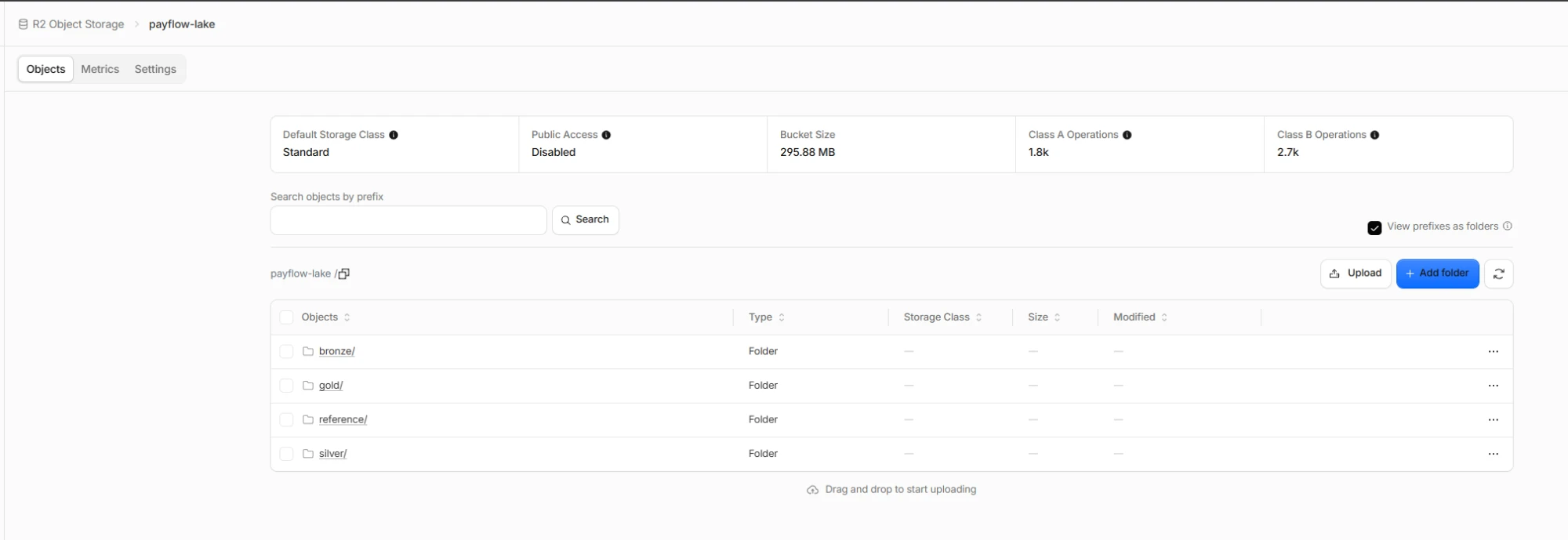
Cloudflare R2: Medallion lake structure
Four layers live in R2 after a full pipeline run: bronze/ (raw Parquet from Airbyte), silver/ (cleaned, typed, deduplicated Delta Lake), gold/ (aggregated ML-ready features), and reference/ (merchant map written by pgvector normalization).
Airbyte connections all green
Three connections running every 6 hours: MongoDB, PayFlow FX Rates API (custom CDK connector), Postgres. All enabled, all healthy.

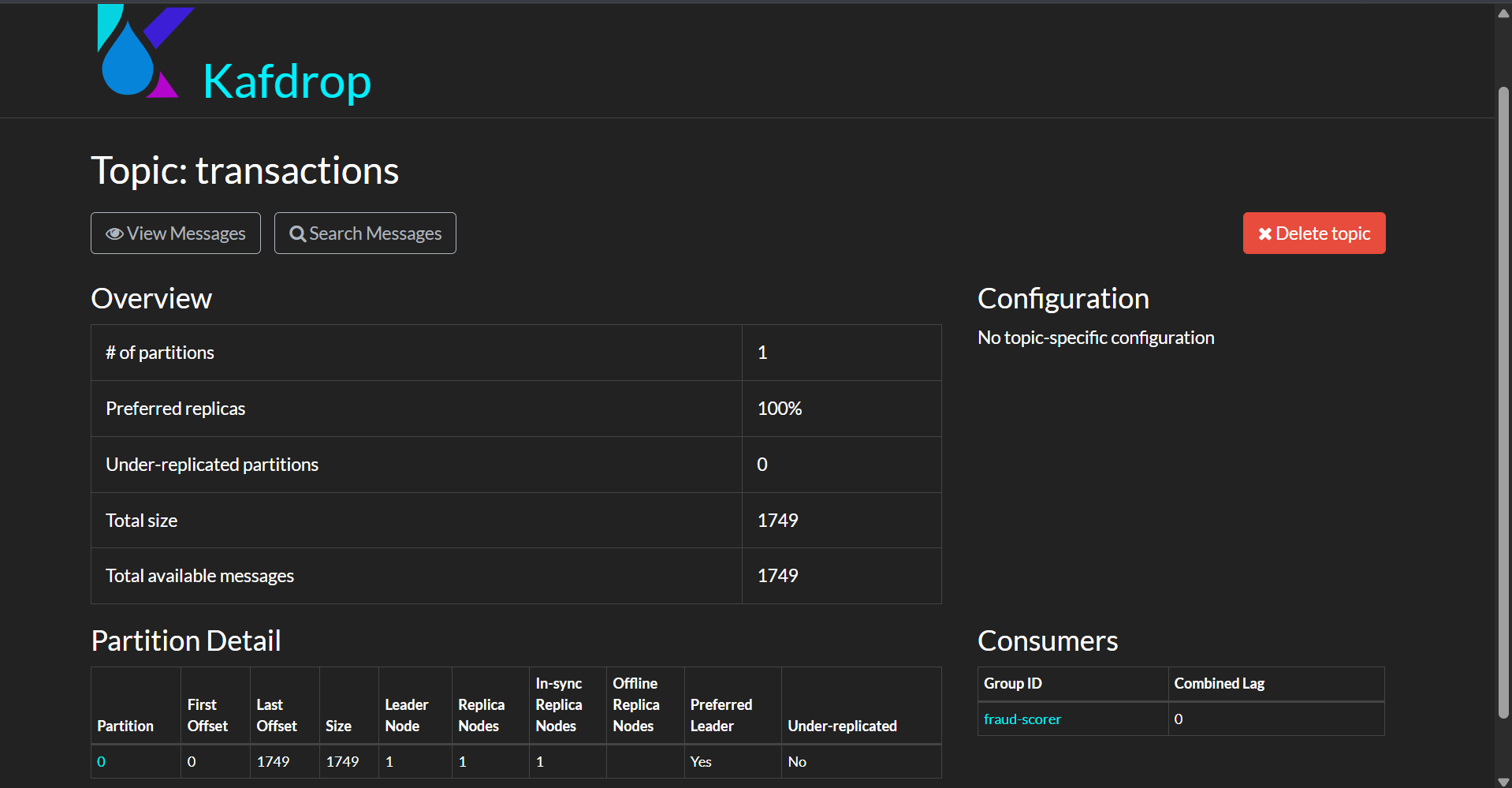
Kafka: 1,749 transactions in flight
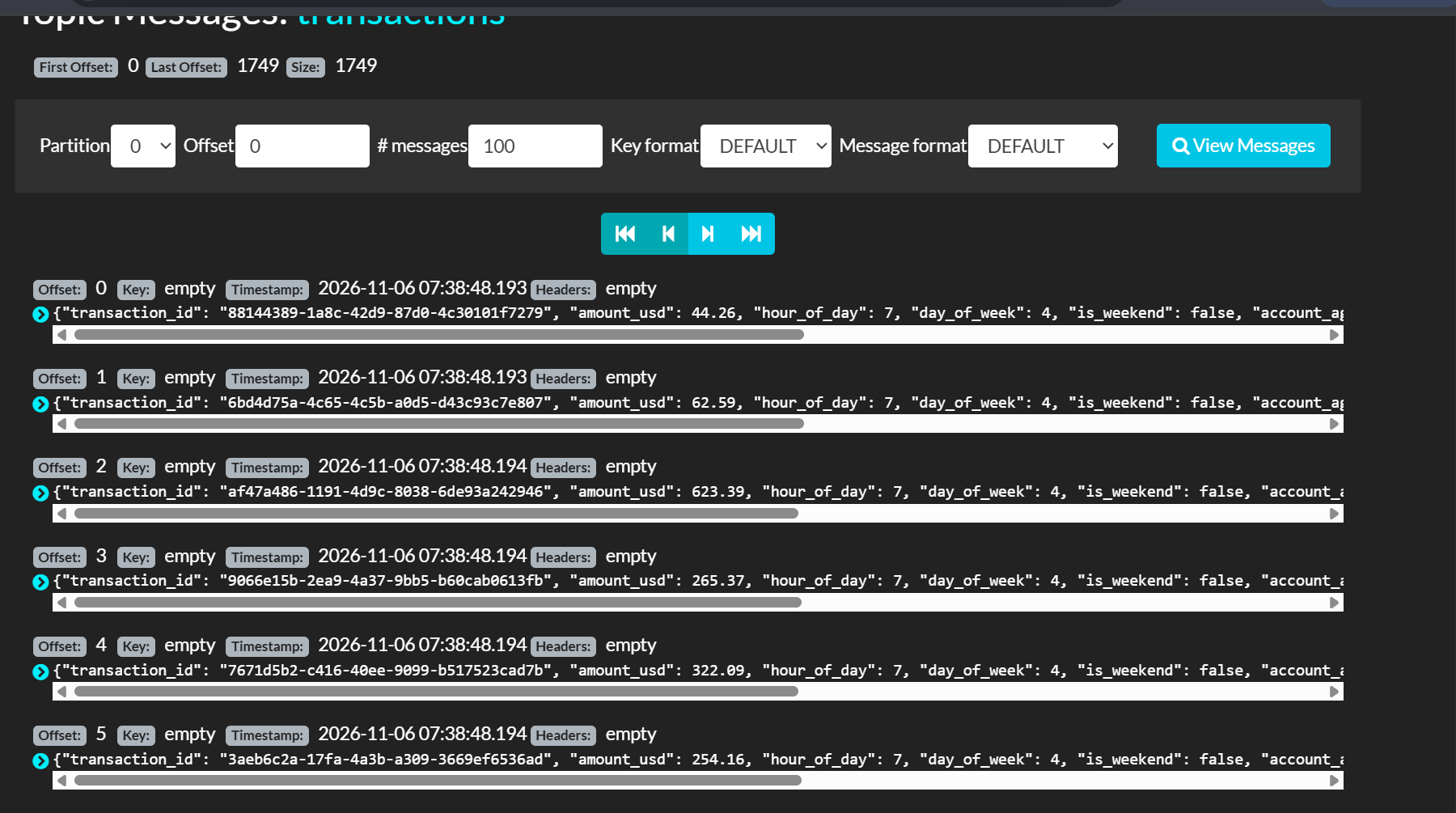
Kafdrop shows the transactions topic with 1,749 messages and consumer group fraud-scorer at lag 0, meaning the streaming consumer is fully caught up. Each message carries the full transaction payload: transaction_id, amount_usd, behavioral features, and account metadata.
Prefect: full pipeline completed
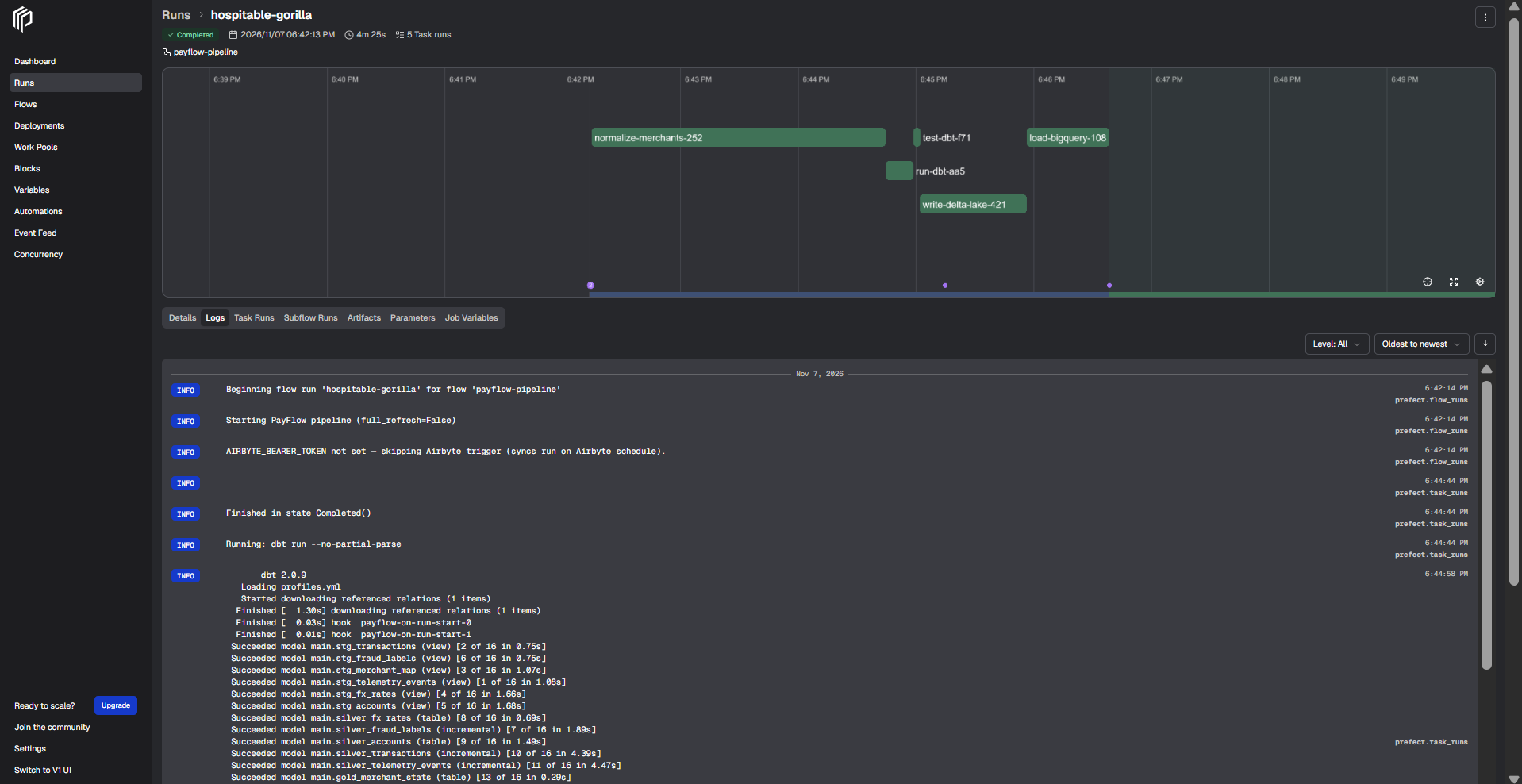
End-to-end Prefect run with all 5 tasks green: normalize-merchants, run-dbt, test-dbt, write-delta-lake, load-bigquery. The Gantt shows each task's duration. This run (Nov 7) built 16 models across staging, silver, and gold; the star-schema marts and the automatic retraining step were added afterwards, so a run today builds 19 models and ends with the retrain check.
Grafana: real-time streaming observability
Prefect covers the batch plane; Grafana covers the streaming plane. The fraud consumer and the /predict service expose Prometheus metrics that Grafana renders live: /predict latency (p50/p95), scoring throughput by decision, Kafka consumer lag, and the approve/review/decline split. Metrics, scrape config and the provisioned dashboard live in infra/.
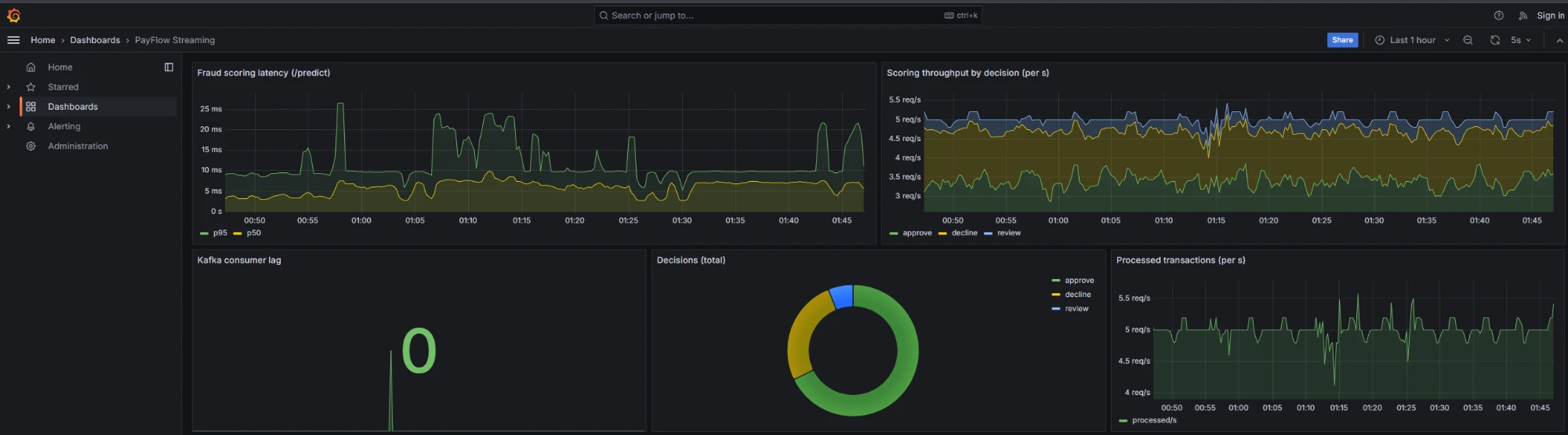
The dashboard is provisioned automatically from infra/grafana/dashboards/payflow-streaming.json when the stack starts (Grafana at http://localhost:3001).
MLflow: fraud detection model metrics
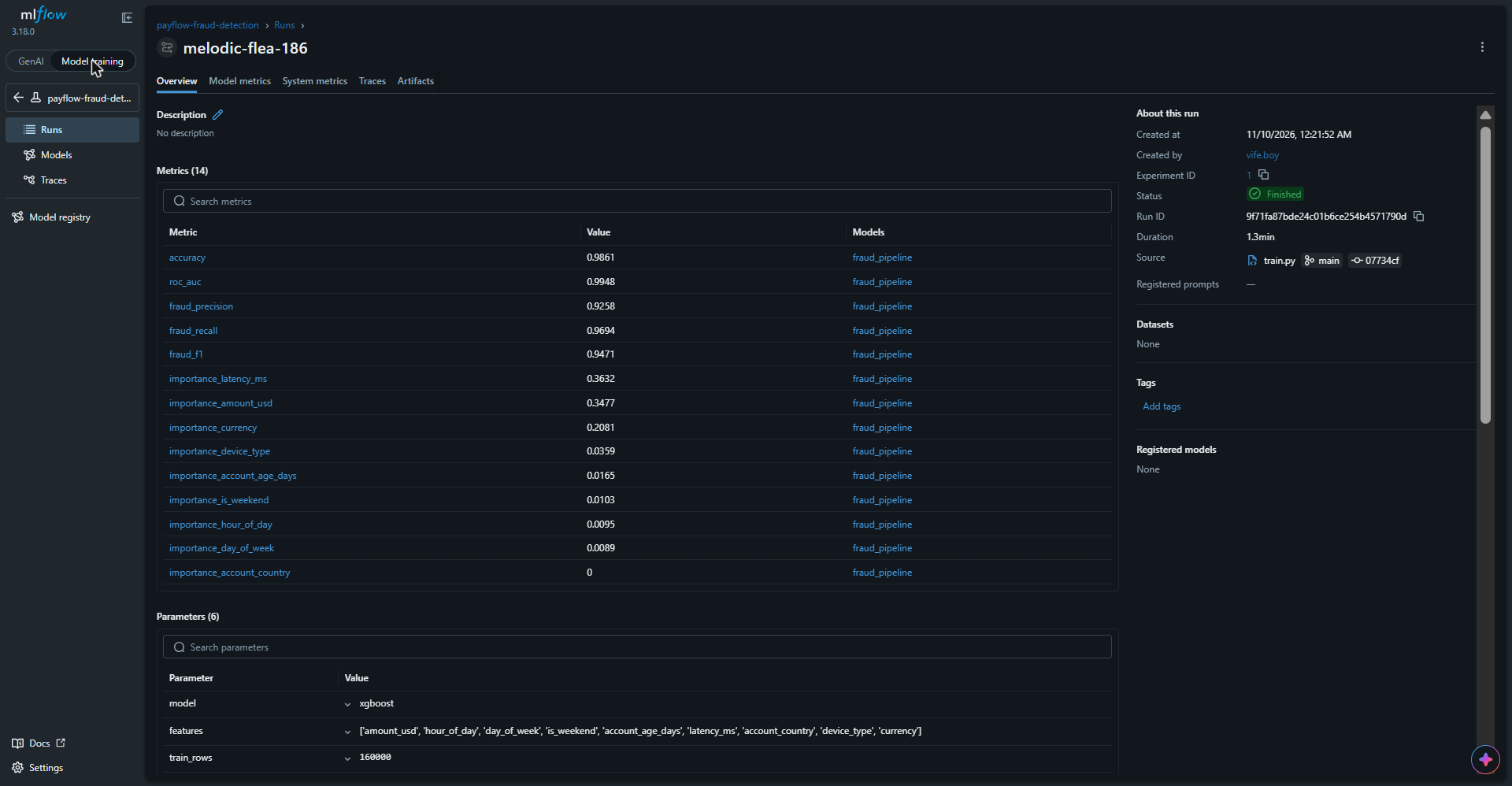
XGBoost pipeline trained on 160,000 transactions (time-based 80/20 split, 40,000 held out). Top features by importance: latency_ms (0.36), amount_usd (0.35), currency (0.21).
| Metric | Value |
|---|---|
| ROC-AUC | 0.9948 |
| Accuracy | 0.9861 |
| Fraud Precision | 0.926 |
| Fraud Recall | 0.969 |
| Fraud F1 | 0.947 |
On the high scores: fraud concentrates in card-testing bursts on digital-goods merchants, and those bursts carry a clear behavioral signature (tiny amounts, low latency) that the model picks up even though it never sees the merchant or MCC category. The ~0.99 ROC-AUC reflects that learnable synthetic signature, not real-world fraud difficulty, where precision and recall are far harder to move; precision here already sits at 0.93, not a perfect score. What carries over to a real dataset is the methodology: a time-based split to prevent leakage,
scale_pos_weightfor class imbalance, and no PII or merchant-name features.
BigQuery: Gold tables loaded
Note: BigQuery Sandbox datasets expire after 60 days. If the tables are gone, re-run
python transform/load_to_bigquery.pyaftergcloud auth application-default login.
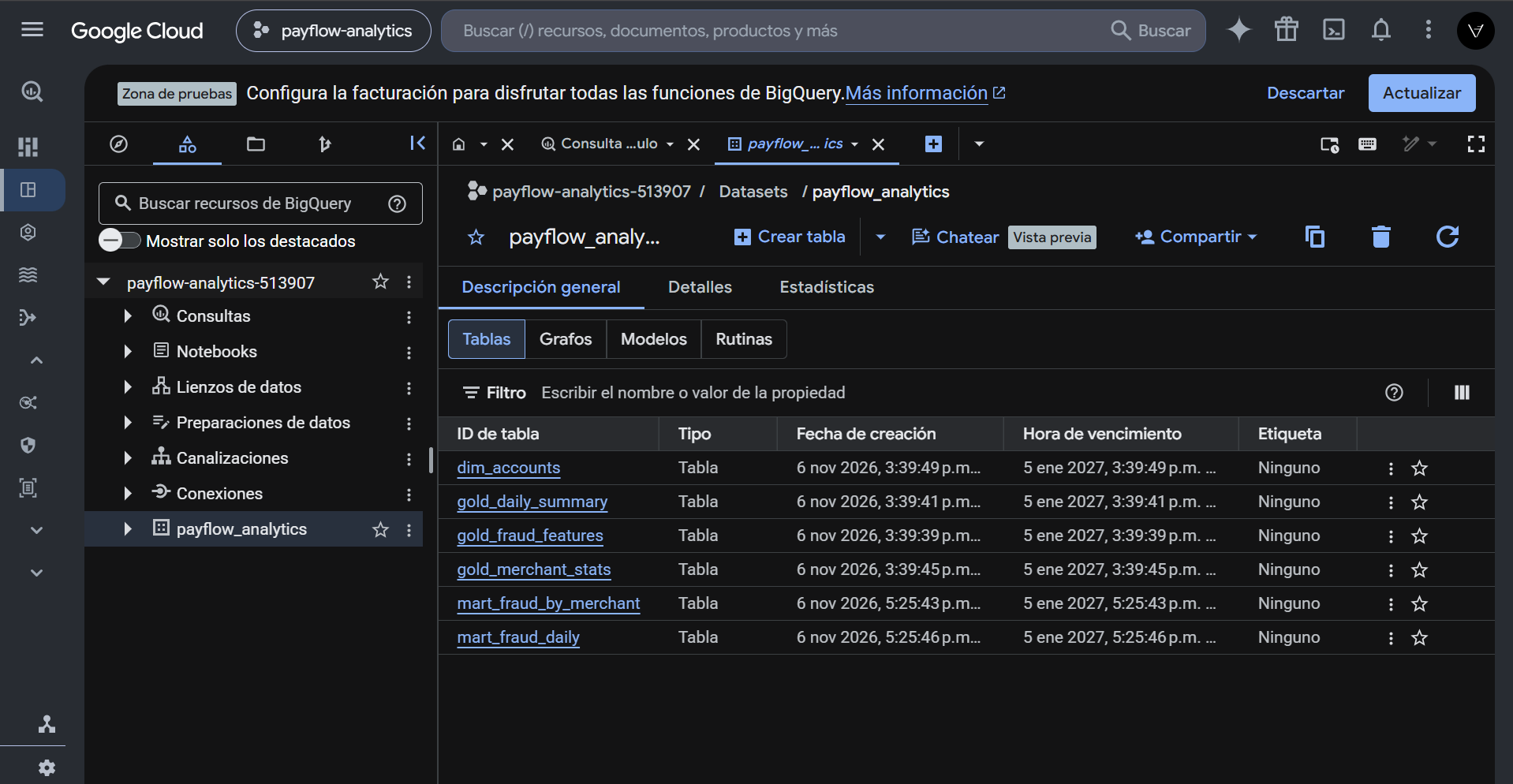
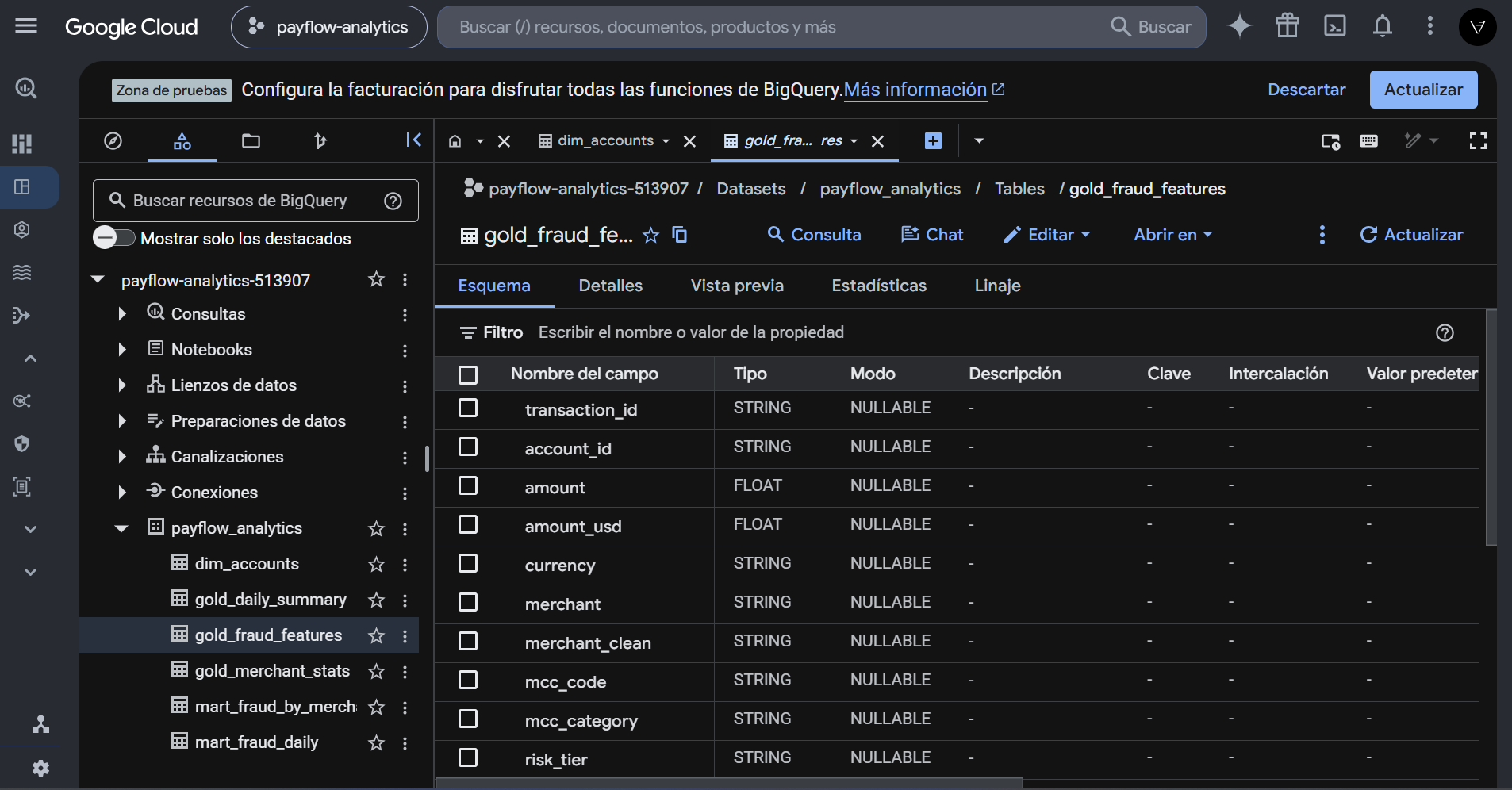
Nine tables in the payflow_analytics dataset: the Gold feature tables (gold_fraud_features, gold_daily_summary, gold_merchant_stats), the star schema (fct_transactions, dim_merchants, dim_date, dim_accounts), and the BI marts (mart_fraud_by_merchant, mart_fraud_daily). Loaded from the DuckDB Gold/mart layer via load_to_bigquery.py using Application Default Credentials.
EDA: Gold fraud features
Exploratory analysis over gold_fraud_features loaded from BigQuery into a Jupyter notebook (notebooks/eda_gold.ipynb).
Sections:
- Fraud rate trend: daily volume and fraud rate over 366 days
- Amount distribution: fraud transactions skew toward the tails
- Fraud rate by device type, MCC category, account type, and currency (the same features that drive the XGBoost model)
- Fraud by hour of day
- Fraud pattern breakdown (
card_testing,geo_impossible,amount_anomaly) - Numeric feature correlation matrix
Note: the outputs stored in the notebook were executed on 2026-11-15 against the current 200,000-row dataset. To re-run it, install
notebooks/requirements.txt, rungcloud auth application-default login, and make sure the BigQuery Sandbox dataset is still active (these tables expire on 2027-01-07). If the dataset expired, re-runpython transform/load_to_bigquery.pyfirst, then execute the notebook, for example withjupyter nbconvert --to notebook --execute --inplace notebooks/eda_gold.ipynb.
GitHub Actions CI: both jobs green
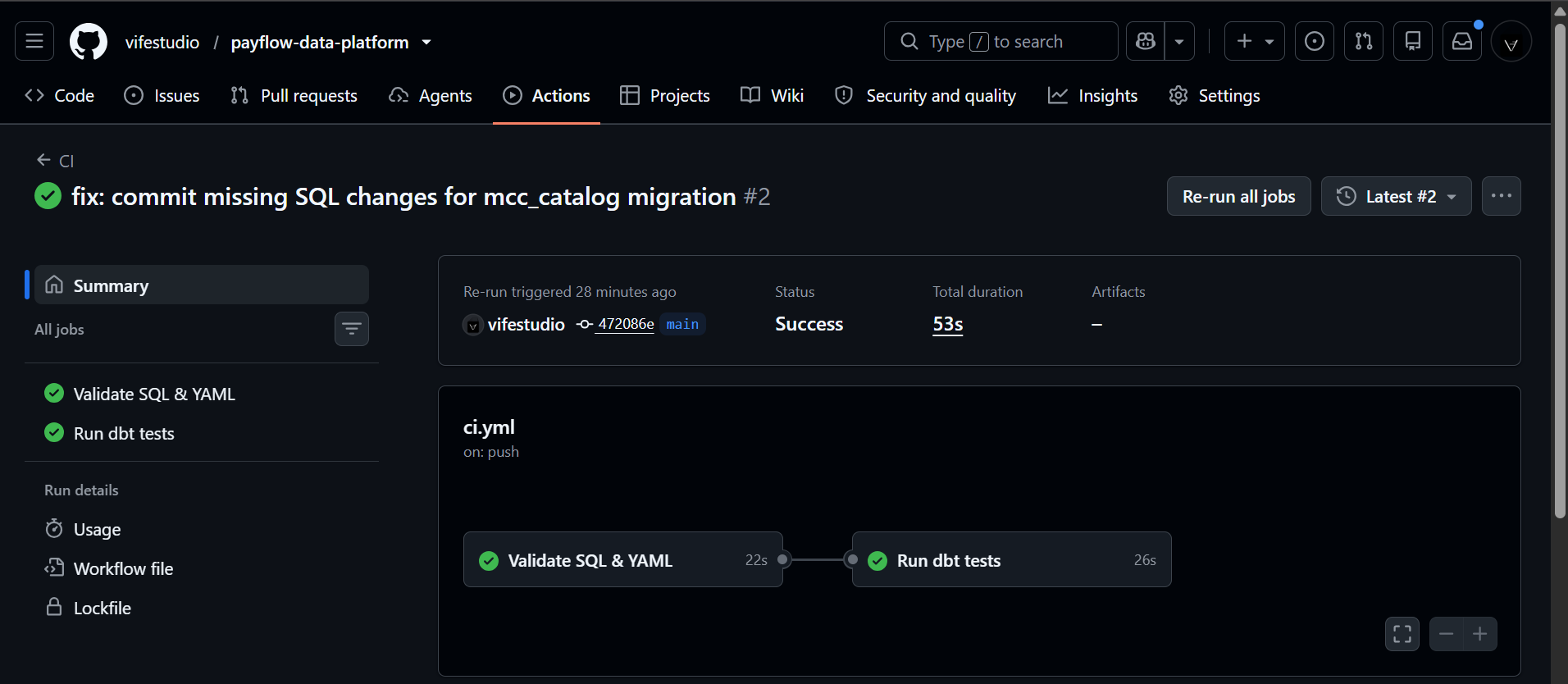
dbt parse validates SQL and YAML on every push without touching R2. dbt seed + run + test runs on main with real R2 credentials. Total duration: 53s.
Looker Studio: fraud analytics dashboard
Open the live dashboard (view-only, no sign-in required).
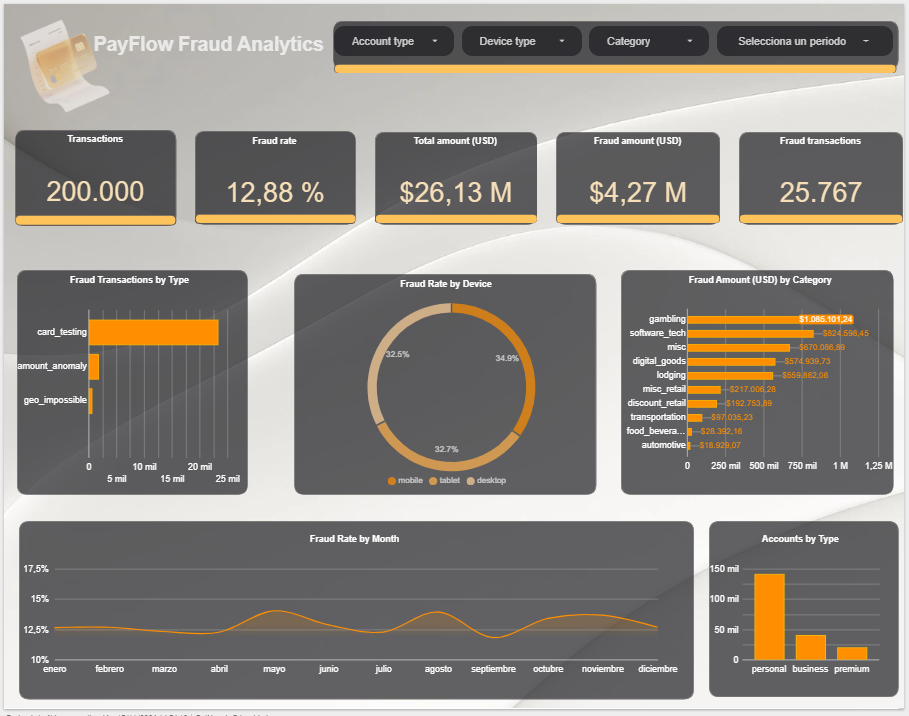
Five KPIs (transactions, fraud rate, total amount, flagged fraud amount, flagged fraud transactions), five charts (fraud by pattern, device, merchant category, month, and account type) and four filters (account type, device type, merchant category, date range). All filters apply to every component.
The dashboard reads a snapshot, not a live BigQuery connection. BigQuery Sandbox tables expire after 60 days, and a live connection would break the public link when they do. So the dashboard uses Looker Studio's Extract Data connector: a copy of
fct_transactions(200,000 rows, eight fields: transaction id, date, account type, device type, MCC category, fraud pattern,is_fraud,amount_usd) stored inside Looker Studio. The three derived metrics (fraud transactions, fraud rate, fraud amount) are calculated fields on top of that extract. Auto-refresh is off. To rebuild it, reload the tables withload_to_bigquery.pyand create a new extract fromfct_transactions.
Reading the numbers: the data is synthetic and the 12.9% fraud rate is injected, far above real-world rates. "Fraud" means rows flagged by
is_fraud, not confirmed losses, so "Fraud Amount" is the amount of flagged transactions.
Docker: the full local stack
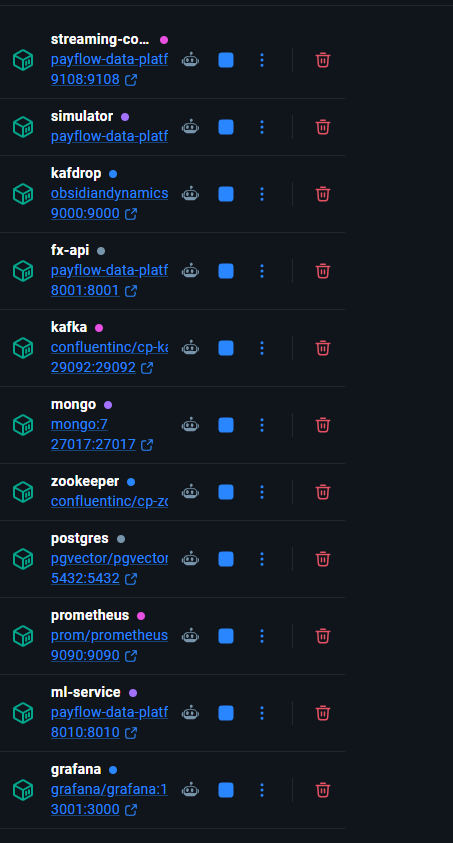
To keep the project at zero cost, everything operational ran locally in Docker Desktop: Postgres (pgvector), MongoDB, Kafka with Zookeeper and Kafdrop, the simulator, the FX API, the ML scoring service, the streaming consumer, Prometheus and Grafana. Cloud usage was limited to free tiers (Cloudflare R2 and the BigQuery Sandbox). Once the Gold tables were loaded into BigQuery, the local stack was no longer needed for analytics and can be recreated at any time with docker compose up -d.
License
MIT, see LICENSE.